



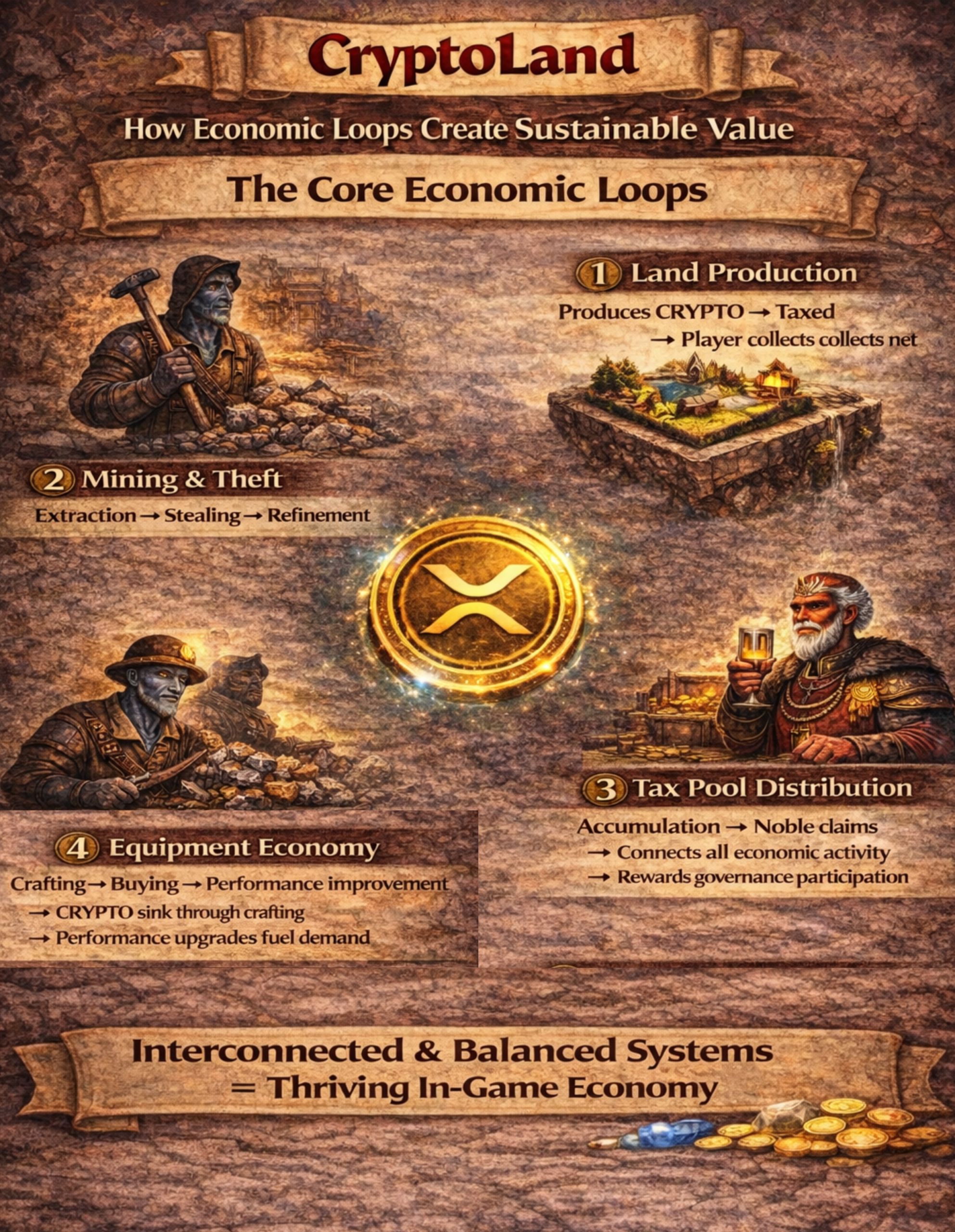
What makes CryptoLand’s economy work? Understanding the economic loops helps you play smarter and see why the game sustains.
The Core Economic Loops
Loop 1: Land Production
Land → Produces CRYPTO → Taxed 10% → Player collects net
- Constant CRYPTO generation
- Taxes feed other systems
- Passive, predictable flow
Loop 2: Mining & Theft
Miners extract ore → Army can steal → Refinement creates CRYPTO
- Active gameplay creates risk/reward
- Theft redistributes to Army players
- Creates player interaction
Loop 3: Tax Pool Distribution
Taxes collected → Pool accumulates → Nobles/Royalty claim
- Connects all economic activity
- Rewards governance participation
- Creates demand for Noble Avatars
Loop 4: Equipment Economy
Artisans craft → Players buy → Equipment improves performance
- CRYPTO sink through crafting
- Player-to-player trading
- Performance upgrades create demand
Why This Works
Multiple Sinks
CRYPTO leaves circulation through:
- Taxes on transactions
- Minting new NFTs
- Equipment crafting
- Various game actions
Multiple Sources
CRYPTO enters through:
- Land production
- Mining refinement
- Pool distributions
Interconnected Players
Every player type needs others:
- Miners need Artisans for equipment
- Army needs Miners to steal from
- Nobles need economic activity for taxes
- Everyone needs Land for base stability
The Balance Challenge
Sustainable games need:
- Sinks ≈ Sources (long-term)
- Enough activity to fund rewards
- Incentives for all player types
- Adjustments as economy evolves
What This Means for You
- Understand your role in the economy
- Diversify across economic loops
- Watch for imbalances
- Adapt as meta changes
Comments are closed